Invoice Finance: How It Works and When Businesses Use It
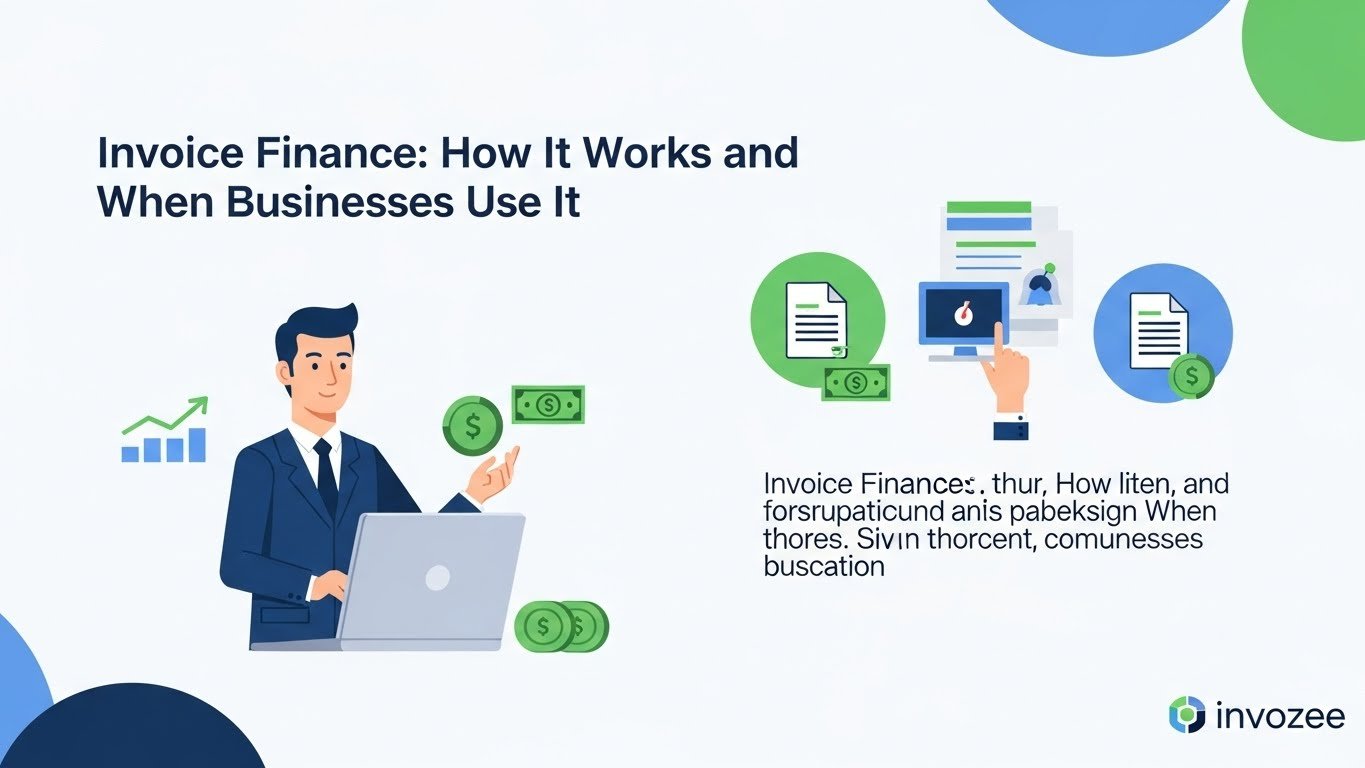
On paper, your business looks healthy: plenty of work, plenty of invoices issued. But if those invoices take weeks or months to get paid, your bank balance can tell a very different story. That gap between “we did the work” and “we got paid” is exactly where invoice finance shows up.
Let’s unpack what invoice finance actually is, how it works in a normal week, and what to watch out for before you sign anything.
Key takeaways
- Invoice finance lets you receive most of an invoice’s value upfront instead of waiting for the customer to pay.
- The finance provider then collects the payment and keeps a fee (and sometimes interest) for providing the advance.
- Invoice finance can ease cash flow pressure but comes with costs and contractual responsibilities.
- Clear, consistent invoices from a tool like Invozee make it easier for providers to assess and fund your invoices.
- This guide is for general information only and is not financial, legal, or tax advice.
- What is invoice finance?
- How invoice finance works step by step
- Common types of invoice finance
- Pros and cons of invoice financing
- Is invoice finance right for your business?
- Why the quality of your invoices matters
- How Invozee supports invoice finance workflows
- Frequently asked questions (invoice finance)
What is invoice finance?
Invoice finance (or invoice financing) is a form of business funding where you use your unpaid invoices as the basis for borrowing. Instead of waiting for customers to pay on 30, 60, or 90 day terms, a finance provider advances you most of the invoice value now and takes their fee when the customer eventually pays.
Put simply, you are swapping some future income for cash today. That cash can cover wages, suppliers, rent, or more growth, instead of sitting locked up in your accounts receivable.
How invoice finance works step by step
There are variations, but most invoice finance services follow a similar pattern.
- You do the work and issue an invoice.
You complete the project, deliver the goods, or provide the service, then send a clear, properly formatted invoice—ideally using a tool like Invozee so the information is easy to understand and track. - You submit the invoice to the finance provider.
Instead of waiting, you send that invoice (or a batch of invoices) to your invoice finance company. - You receive an advance.
They advance you a percentage of the invoice value—often somewhere in the region of 70–90%. The exact percentage depends on your agreement and the perceived risk. - Your customer pays later.
When the invoice falls due, your customer pays. Depending on the type of invoice finance, they may pay the finance provider directly or pay into a controlled account. - You receive the balance minus fees.
Once payment is in, the provider sends you the remaining amount of the invoice (the part they did not advance) minus their fees and any interest.
From your point of view, you gain access to cash earlier, which can smooth out the spikes and dips in your cash flow—especially if you work on long payment terms.
Common types of invoice finance
The term “invoice finance” covers a few different models. Knowing the basics makes discussions with providers much less confusing.
Invoice factoring
- The finance provider often manages credit control and collections.
- Your customers may know that a third party is involved.
- Can reduce your admin but sometimes feels less “invisible”.
Invoice discounting
- You usually keep control of chasing payments.
- Can be “confidential”, so customers may not realise you are using finance.
- Often used by slightly larger or more established businesses.
Whole ledger finance
- You finance a whole portfolio of invoices, not just selected ones.
- Can provide a more predictable stream of funding.
- May come with ongoing commitments and covenants.
Selective / spot invoice finance
- You choose specific invoices to finance (for example, a large one-off project).
- Useful when you do not need continuous funding.
- Gives more flexibility but can have higher per-invoice costs.
Providers and banks sometimes use slightly different labels, but most offerings will sit somewhere on this spectrum. Many small and medium businesses use guides from banks or business support organisations, alongside their own accountant’s advice, to compare options before committing.
Pros and cons of invoice financing
As with any funding, invoice finance is a tool. It solves some problems and creates tradeoffs you should understand.
Advantages of invoice finance
- Improved cash flow: Turn unpaid invoices into cash without waiting for long payment terms.
- Growth support: Take on larger orders or projects without worrying so much about cash timing.
- Linked to sales, not collateral: Funding is based on your invoices rather than just physical assets.
- Flexible (in some models): Selective finance lets you use the service only when needed.
Disadvantages and risks
- Cost: Fees and interest reduce your margin on each financed invoice.
- Contract complexity: Agreements can include minimums, notice periods, or other conditions.
- Customer perception: With some factoring models, customers see that a third party is involved, which may raise questions if poorly explained.
- Dependence: Relying heavily on invoice finance for day-to-day survival can mask underlying cash flow or profitability issues.
This is why many finance and small business resources recommend walking through invoice finance options with an accountant or financial adviser before you sign—especially if you are considering a long-term or whole-ledger arrangement.
Is invoice finance right for your business?
Invoice finance is not a magic fix, but it can be surprisingly helpful in the right context. A few questions can help you decide if it is worth exploring.
1. Do you sell on credit terms?
If your customers pay on the spot (for example, a coffee shop), invoice finance is not really relevant. It becomes interesting when you issue invoices with terms like “Net 30” or “Net 60” and regularly wait for payment.
2. Are late payments putting pressure on you?
Invoice finance can be a way of smoothing cash flow if late payments and long terms regularly force you to delay your own bills, payroll, or growth plans.
3. Are your margins strong enough?
The funding cost has to come from somewhere. If your profit margins are thin, invoice finance fees may hurt more than they help. In those cases, improving pricing, costs, or payment terms may be a better first move.
4. Are your invoices and records in good shape?
Providers look closely at your invoicing habits. Clear, consistent invoices—with accurate line items and sensible payment terms—make it easier for them to fund your receivables at a reasonable cost. If your paperwork is messy, it is often worth fixing that first.
Several of the habits we talk about in other Invozee articles—like how to create an invoice for freelancers, understanding invoice vs receipt, and using free invoice templates— also make your business look more organised to lenders.
Why the quality of your invoices matters
With invoice finance, your invoices are not just documents—they are the actual assets being funded. That makes their quality and consistency much more important.
Clarity reduces questions and delays
A well-structured invoice that clearly shows who owes what, for which work, and on which date is easier for everyone to trust: your customer, your finance provider, and your own team. Confusing invoices increase the risk of disputes and late payments, which can undermine the whole point of invoice finance.
Consistent numbering and records
Finance providers usually want to see a clean sequence of invoice numbers and a sensible history of paid and unpaid invoices. Tools like Invozee make it easier to keep that numbering consistent and your records tidy, instead of juggling spreadsheets and manual entries.
Professional presentation
Professional-looking invoices can support your reputation with both customers and lenders. They signal that you take your operations seriously and that you are likely to handle repayment and communication in a structured way.
How Invozee supports invoice finance workflows
Invozee does not provide invoice finance itself, but it can play a big role in making you “finance ready” if and when you decide to explore it.
Create clean, consistent invoices every time
With Invozee, you can:
- Use templates that keep your layout and terms consistent.
- Quickly generate invoices after work is completed or at the end of each billing cycle.
- Include clear line items, payment terms, and references that match your contracts or purchase orders.
Keep a searchable history of your accounts receivable
Instead of digging through folders or old PDFs, you can see:
- Which invoices are unpaid, paid, or overdue.
- How much certain clients owe you at any given time.
- Patterns in your cash flow that may support your application for invoice finance.
Support for different billing models
Whether you bill in advance, in arrears, or mix of both, you can set up templates to match your workflow. For example, if you use billing in arrears, invoice finance can be layered on top of those end-of-period invoices once they are issued.
Use strong invoicing as the foundation for smarter finance
Invoice finance can help you bridge cash flow gaps, but it works best when your invoicing is already organised. Use Invozee to create clear, consistent invoices and build a solid history—so if you ever decide to explore invoice finance, you are starting from a position of strength.